

Anticipatory flight anxiety: Why your panic starts weeks before you reach the airport
Does flight anxiety start long before you reach the airport? Learn how your brain rehearses threats and how hypnotherapy can support a calmer journey.
Clinically reviewed: 6 June 2026
It’s 8:00 PM. You’ve had dinner and are just starting to relax after a busy day. Your mind starts to wander, and suddenly there’s a pang in your chest as you remember your upcoming flight. Off go your thoughts like a runaway train, with remembered past events and imagined worst-case scenarios bumping together and driving your anxiety.
You’re sitting safely in your living room, but you feel as though you are on that plane right now, afraid of your own stress response.
For many people, the fear of flying is as much about what happens in the lead-up to the flight as what happens on the day. This is known as anticipatory anxiety, and it can heavily impact your joy and excitement in the weeks before a holiday.
The pattern of the problem
One client recently described her anxiety as “sneaking in” ahead of a flight, lingering in the back of her mind and intensifying as the departure date drew nearer. Another described seeing a plane from her office window: “Suddenly I’m on that plane and having a panic attack.” Both of them said, word for word: “I just want to look forward to my holiday.”
To shift this, I usually start by unpacking exactly what your experience of anticipatory anxiety looks like. When does it happen? What triggers can we identify? Where does the anxiety start—in the body or in the mind?
This information sheds light on the pattern of the problem, which shapes how I help you gently update those subconscious responses. Together, we reframe your relationship with anxiety. Though it doesn’t always feel like it, anxiety is a pattern with a purpose—it is your mind’s attempt to keep you safe from a perceived threat. Anxiety is not part of your personality, and it does not define you.
Why anticipatory flight anxiety feels so real
The intense experience of flight anxiety might make you feel as though there is something “wrong” with you. However, it is not a glitch; it is a highly active survival mechanism.
Part of anticipatory anxiety is predicting how we are going to feel in certain situations, based on past experiences and our imagination. The brain is a “predictive machine.” In the absence of certainty—of knowing exactly what comes next—anxiety tells our brain to fill in the blanks, often with worst-case scenarios.
Why? It is your mind’s attempt to help you feel “prepared.”
The Australian long-haul factor
For many Australians, the long-haul flight is the biggest hurdle. As one client put it, “I can do Melbourne to Sydney, but Sydney to London via Dubai is a whole other thing.”
The truth is that this constant worry causes us suffering in the present moment, and it can even have the effect of a self-fulfilling prophecy. What we focus on, we often amplify. So, how about learning to use the power of the subconscious mind in a more supportive way?
Break the cycle of travel stress
You don't have to spend the weeks leading up to your holiday in a state of high alert. Discover how updating your automatic responses can help you actually look forward to your trip.
Learn about hypnotherapy for flight anxiety
The biology of “threat rehearsal”
To understand how powerful this predictive machine is, imagine a big, fat, juicy lemon sitting in the palm of your hand.
Hold your hand out and feel the weight of it. Close your eyes. Now imagine taking a big bite—your teeth cut into the tangy zest and powdery pith to the spectacularly sour juice inside. Notice the textures of the lemon as you chew, your mouth salivating in an attempt to flush the sour flavour away.
Now open your eyes. There is no lemon.
And yet, when I ask people to do this, their faces screw up, and their mouths water. Why? To demonstrate a critical point: our wonderful, powerful human brain cannot distinguish between a vivid thought and a real event. Your mind can make a lemon real, causing your body to react as though it is happening right now.
Turning the “unreal lemon” into lemonade
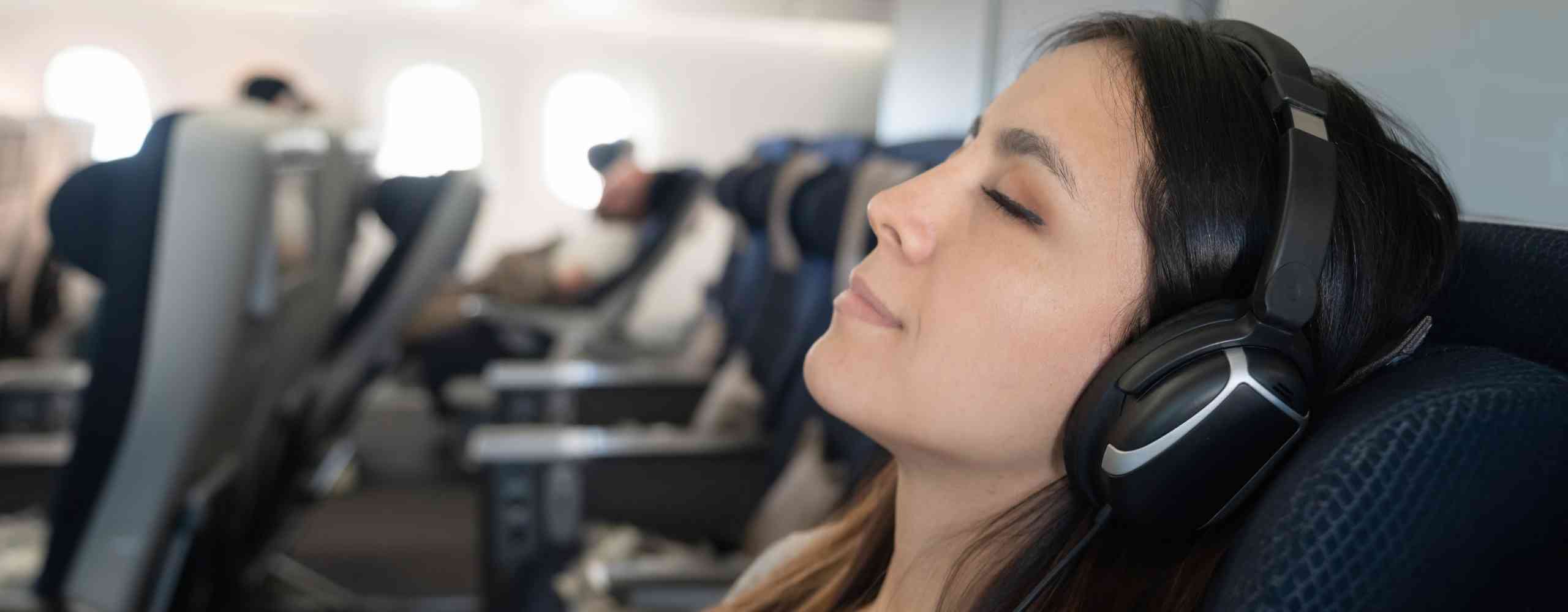
The good news is that we can use this “trick of the mind” to our advantage. Instead of practising panic in your mind, you can prepare for plane travel while feeling safe and calm. With guidance, you can trade one experience for another.
Why “just relaxing” doesn’t work
Chances are that you are familiar with the facts about the safety of modern air travel. You have probably heard well-meaning friends or family tell you that you are safer in a plane than in a car. And chances are that this made little difference to how you actually feel about flying.
This is because your learned fear response is not a problem of logic or reasoning; it is a problem of emotion.
Logic and reasoning are the domain of the conscious, rational mind. Emotional responses and learned patterns of behaviour—such as pulling your hand away from a hot kettle or being fearful of flying—belong to the subconscious mind. Its primary focus is your safety and survival.
There is a saying in my line of work: when emotion and logic are at odds, emotion always wins. The subconscious mind does not do facts and figures. It does emotions and associations.
How clinical hypnotherapy supports a shift
The language of the subconscious mind is imagery and story. It associates events with meaning. It also relates to metaphor and bodily sensations, known in somatic work as the “felt sense.” This is the language I use in strategic clinical hypnotherapy.
Working together, my goal is to help you update patterns that no longer serve you.
- I do not demand change. I do not belittle or berate the anxiety.
- I offer different options. I present new ideas for your subconscious mind to “try on” like clothing in a store.
- I aim for adaptability. I look for updated, more helpful patterns that still prioritise your safety, but feel a lot more comfortable.
Through this exploration, you can consciously and subconsciously cultivate new ways of thinking and doing, gently letting go of the unhelpful patterns that have made travel so exhausting. I help you distance yourself from past experiences in a way that feels safe and supportive, guiding you to update your brain’s response to air travel.
Explore a calmer way to travel
If you are already feeling the weight of an upcoming trip, building your toolkit early can help create a calmer experience. Learn how Frankie can support you.
Explore hypnotherapy for fear of flyingYour journey starts before takeoff
The anxiety in the lead-up to takeoff is sometimes overlooked, yet if it is left to run, it can gain momentum and even play a role in worsening your experience on the day of your flight.
If anticipatory anxiety is in the mix for you, my goal isn’t just to get you through the flight. It is to help you reclaim your calm in the weeks leading up to it, ensuring you are equipped with practical tools to regulate your nervous system.
Changing your experience could be easier than you think, and help is available wherever you are. Before you book your flight, consider reaching out for a chat. Chances are that we can work together to help shift that anxiety toward a sense of prepared curiosity.
You don’t get to fly the plane, but you can learn to guide your brain’s response to the journey.
Take the first step toward more clarity, confidence and calm
Request a brief initial phone call with Frankie to find out if hypnotherapy may be helpful for your specific goals or challenges.
Request a phone call
Obligation-free100% confidential